


Igor Stravinsky:
The Rite of Spring (1913)
Part I: Adoration of the Earth (L'Adoration de la Terre )
Introduction
Augurs of Spring (Dances of the Adolescents) (Les augures printaniers, Danses des adolescentes)
Ritual of Abduction (Jeu du rapt)
Spring Rounds (Rondes printanières)
Ritual of the Rival Tribes (Jeu des cités rivales)
Procession of the Sage (Cortège du sage)
The Sage (Adoration of the Earth) (Le sage)
Dance of the Earth (Danse de la terre)
Part II: The Sacrifice (Le Sacrifice)
Introduction
Mystic Circles of the Young Girls (Cercles mystérieux des adolescentes)
Glorification of the Chosen One (Glorification de l'Élue)
Evocation of the Ancestors (Évocation des ancêtres)
Ritual Action of the Ancestors (Action rituelle des ancêtres)
Sacrificial Dance (The Chosen One) (Danse sacrale (l'Élue))
Sergei Prokofiev
Alexander Nevsky, cantata for mezzo-soprano, choir and orchestra Op. 78 (1939)
Russia Under the Mongolian Yoke
Song About Alexander Nevsky
The Crusaders in Pskov
Arise, Men of Russia
The Battle on Ice
The Field of the Dead
Alexander's Entry into Pskov
Originating from the rich choral singing tradition, from the very spirit and cultural roots of the nation that put legends and myths about its existence into song to save them from oblivion, the Choir of the Serbian Broadcasting Corporation (RTS) appeared before the concert audience some seven decades ago and established its position as the leading professional vocal group, acknowledged well outside of this country’s borders. Thirty years of assiduous work with former chief conductor Borivoje Simić brought the Choir to full perfection, as confirmed by numerous critics’ reviews and overjoyed audiences.
Important tours of the Choir during the 1970s provoked an avalanche of positive echoes. The successes of the Choir also continued under chief conductors Mladen Jagušt, Vladimir Kranjčević and Bojan Suđić.
The RTS Choir had very successful performances on numerous tours both locally and internationally. The guest performance of the Choir in Rome, where it performed Benjamin Britten’s War Requiem with Choir and Orchestra of St. Cecilia Academy and Mstislav Rostropovich as a conductor in 1987, merits special mention. Other important events in the Choir’s history include guest performances in Naples, where it performed Parsifal by Richard Wagner with the Teatro San Carlo Orchestra and conductor Gustav Kuhn in 1988, and also in Spain, where it performed two capital works of Johann Sebastian Bach (Christmas Oratorio and Passion by Mathew), with the RTS Symphony Orchestra in 1989 and in 1991.
The Choir is the Winner of the City of Belgrade October Prize in 1982 for the concert and recording of the entire opus of Stevan Mokranjac in 1981, and Zlatni beočug in 1989 and 2007 together with the orchestra.
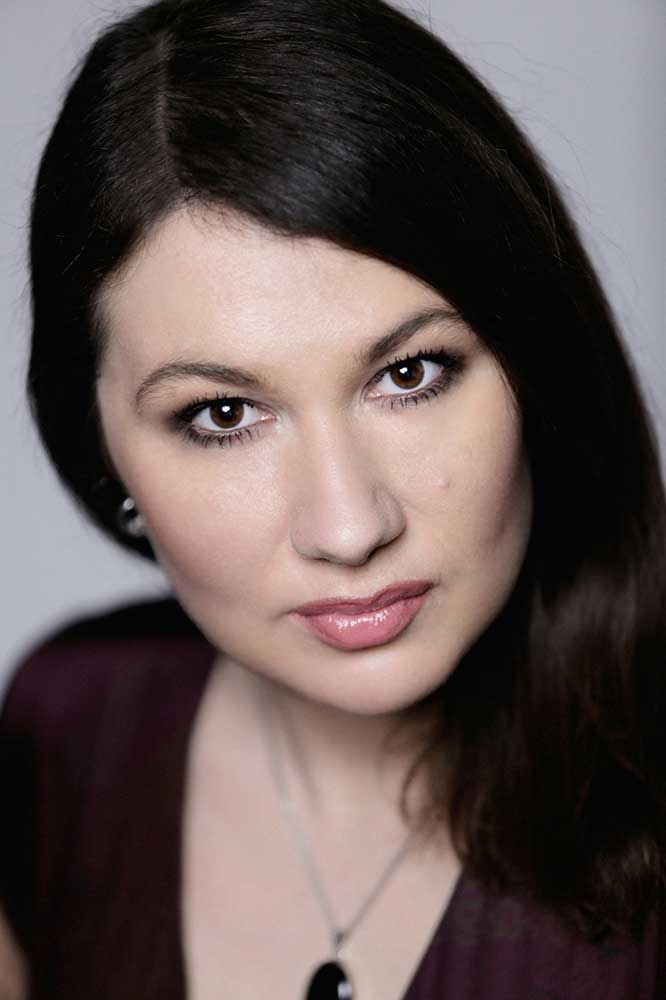 Anna Viktorova
Soloist of Moscow “Novaya opera” theatre. Studied in Moscow Tchaikovsky conservatory and Accademia Teatro alla Scala, Milano.
Prize winner of many international competitions, such as Maria Callas Grand Prix, Athens; Tchaikovsky competition, Moscow; Elena Obraztsova competition, Moscow; Galina Vishnevskaya competition, Moscow; Riccardo Zandonai competition, Riva del Garda; Veronica Dunne competition, Dublin; China singing contest, Ningbo; Mykola Lysenko competition, Kiev; Byulbyul competition, Baku.
Opera and concert repertoire include such roles as Amneris in Aida, Marina Mnishek in Boris Godunov, Dalila in Samson et Dalila, Olga in Eugeny Onegin, Polina in The Queen of spades, Lyubasha in The Tsar's bride, Alto solo parts at Verdi’s Requiem, Beethoven’s 9 symphony, Rossini’s Stabat mater and others.
Appeared on stages of Moscow Bolshoi theatre, Teatro Municipal del Santiago de Chile, Teatro alla Scala Milano, Teatro Massimo Palermo, Teatro Comunale Bologna, Teatro Nazionale di Roma, Latvian National opera, Israeli Opera house, Zuerich Tonhalle, Amsterdam Concertgebow and others.